Showing posts with label Barbarous Relics. Show all posts
Showing posts with label Barbarous Relics. Show all posts
Tuesday, April 18, 2017

Sunday, July 12, 2015
Ignorant Bigots: Not Just a Southern Thing
The Dayton Daily News shows up at the local country music festival to interview local folks who were flying the Confederate battle flag. Ignorance ensues:

Matt Hill proudly flew a Confederate battle flag below the American flag and a POW-MIA flag at his campsite at the Country Concert in Ft. Loramie on Thursday. For Hill and countless of others, the flap over the rebel flag being removed Friday from South Carolina’s capitol grounds is “ridiculous.”
“The first one stands for our country. There’s nothing more important than that flag right there. That goes on top,” Hill, 39, a white man from Leo, Ind. said as he pointed at the American flag. “The POW (flag) is for every man and woman that serves this country. We’ll never forget them and what they’ve done for this country. And that Confederate flag goes right along with that POW flag. That flag is (as much) a part of this country as is the Statue of Liberty. It was part of the South and the Civil War.”
Even as the same symbol was removed from outside the state capitol building in South Carolina following an extraordinary debate over the pain its mere presence causes, fans at the Country Concert — held in Ohio, a state that wasn’t part of the Confederacy — seems almost removed from that changing current. The flag is disappearing even in places where it traditionally flies, such as NASCAR races, but throughout the crowd in this days-long tribute to country music, people displayed the flag proudly and defiantly, sending a clear message that the debate that began in South Carolina is far from over.
Tim Bown, 58, of Hamilton is in favor of flying the Confederate flag, and he said officials in South Carolina should not have caved to the “1 percent, the people who whine all the time.”
“Whoever’s whining the most gets the most attention,” said Brown, who was not at the Country Concert. “That’s the problem, you’ve got a small group that’s complaining all the time. You get tired of it.”...
“We definitely do not think that it should be banned, that’s for sure, for anybody,” said Michaela Goettemoeller, 18, of Minster. She and her group of friends who displayed both American and Confederate flags at their campsite.
“It’s not really a racist thing, like, I saw on Facebook that there was a black guy pulled over on the side of the road and nobody else would help him and the people with the Confederate flag helped him out,” Goettemoeller said. “So, it’s not about racism. It’s about heritage.
“Growing up in a small town, everybody I grew up around had the Confederate flag, so, I just took it as my own.”

I assume Mr. Homan is referring to southern Mercer County pride, because I would wager he has no connections south of the Mason-Dixon line. But, somewhat in his defense, southern Mercer County, along with Fort Loramie and the rest of the German-settled area there has some pretty ugly racial history of its own:
So, does flying the Confederate flag signify support for racism, secession of slave-holding states from the United States in order to maintain the institution of slavery, opposition to civil rights, disenfranchisement, white supremacy and hundreds of years of violence and repression of blacks recorded in U.S. history? Not according to Ms. Goettemoeller (video below). For her, it is all about "heritage." In many ways, she is wrong, because the flag represents all of the things mentioned above. In some ways, though, she is right, but it definitely isn't a heritage to be proud of.Although he competed stride for stride with other members of the Virginia aristocracy by amassing over 8,000 acres of land and 400 slaves, John Randolph had doubts about the morality of the use of slaves all of his life.He was one of the first plantation owners to recognize the benefits of educating his slaves and treating them as humanely as possible. Randolph personally taught many of them to read and write. He also organized them into groups and gave each separate tracts of land for which they were to be responsible - an unusual approach in those days.Economic expediency compelled him to accept slavery as a fact of life while he lived, although he continually spoke against its evils. John Randolph never married. He battled the effects of tuberculosis all his life, and the use of opium as a pain killer resulted in his addiction to the substance. At the time of his death in 1833, three wills were found, and each granted freedom to all 400 of his slaves. His opium addiction, along with his contrarian views on issues, including slavery, caused many to question his sanity. The ownership of slaves meant economic power, and Randolph's next of kin immediately filed a will contest action, alleging he was incompetent.Thirteen years of legal battles followed. However, it was ultimately determined that Randolph's will of 1821 was valid. In that document, his intent was made clear: "I give and bequeath to all my slaves their freedom, heartily regretting that I have been the owner of one." John Randolph had gone to some lengths to see that his plan would be carried out. He set aside $30,000 for the purchase of land in Ohio and supplies for their journey to freedom. He secured the promise of an old friend and judge, William Leigh, to settle the newly freed slaves in Ohio.Although it was perhaps unknown to Randolph and Judge Leigh, Ohio in the 1840's was anything but a hospitable place for people of color. Just a year after Ohio had become a state in 1803, the General Assembly passed a law entitled "An Act To Regulate Black and Mulatto Persons."The law decreed that "No Negro or Mulatto should be allowed to settle in the state unless he could furnish a certificate from some court...of his actual freedom...The Blacks already living in the state must register before the following June with the county clerk..." No black person could register without paying a registration fee of twelve and a half cents. Whites were forbidden to employ a Negro unless he had a certificate of freedom.The newly freed Randolph slaves, now numbering 383, left Virginia on June 10, 1846 - thirteen years after being given their freedom. They ranged in age from an infant less than one year old to Granny Hannah, who had passed the century mark.With them they carried a certificate of the Clerk of Court of Charlotte County, Virginia, which listed the first names and a description of all the freed slaves. The document confirmed that Shadrach, (No. 514), born in 1796, was among those freed. He was destined to become an interesting part of Sidney history. Also listed was Carter (No. 421). He would take the last name of Lee after arriving in Shelby County, and his descendants would include Sidney's first black mayor.This was no ordinary group of southern blacks. Randolph had to seen to it they were educated. Typical was Clem Clay, who would become an engineer after settling in Ohio. Most had developed trade skills. Some had horses, but the majority walked the 500 miles to what they were sure would be the Promised Land.Judge Leigh had carefully made his plans. According to research later compiled by Rossville, Ohio historian Helen Gilmore and late local author Leonard Hill, Leigh purchased about 3,200 acres of fertile Mercer County ground for in excess of $6,000. It is probable that Judge Leigh had heard of Carthagena, a Mercer County colony of free Blacks established by Augustus Wattles, a white Quaker, in the 1830's. Leigh purchased some land near Carthagena, and much land in the vicinity of Celina.After making it to Cincinnati, the adventurers worked their way up the Miami Erie Canal toward Mercer County. They never made it. Waiting at the dock in New Bremen were armed white settlers. Author Trudy Krisher recounted the scene in an article in a recent edition of Ohio magazine. The bewildered Negroes listened as three resolutions read out loud, one of which stated: "Resolved, That we will not live among Negroes; as we have settled here first, we have fully determined that we will resist the settlement of blacks and mulattos in this county to the full extent of our means, the bayonet not excepted." In later years, when the dispossessed land owners inquired about their land, they were told it had been flooded and was useless. (In fact, according to Helen Gilmore, there is some evidence that water was released from Grand Lake St. Marys to temporarily cover some of the land.)An editorial on the Cincinnati Gazette on July 2, 1846, commenting on the Randolph Slaves, summed up the feelings of many in Ohio at that time: "And now the poor creatures are among us! Why should this be? The people of Virginia...hear the call of death...the first step is to free the slaves, that they may lull the unquiet knawings of conscience- next to send them to Ohio so that they may be free. What right have they to be pouring in upon us their helpless, new made free?"The boats continued south on the canal to Piqua. In testimony given in a subsequent trial involving their land, Clem Clay recalled that they all left Piqua soon after to "come to a place called Sidney." The former slaves were first taken to a place in Shelby County Clay referred to as 'Carey's Plantation'. (The authors believe this is the present day Fort Loramie.)The July 14, 1893, edition of the Sidney Journal later carried an account of the reception they encountered. "In July of 1846 quite a commotion was caused in the village by the arrival of a boat carrying as passengers...about 100 Randolph slaves, just set free. The boat passed up to the vicinity of Berlin (Now known as Fort Loramie), but were not allowed to land. A mob received them with sticks and stones....It was the exclamation of one of the old Negroes that he guessed his 'Master (referring to Randolph) was his best friend, after all."Clay and the others went next to Sidney. A mob began to gather here as well, but appeals were made to their charity. Joseph Cummins, Guy Kelsey and others in Sidney convened a meeting at a local hotel to debate what to do. It was decided to allow a number of the Negroes to stay in Sidney. Clay recalled: "Well, a good class of white people took some on the farm, and some around to the dwelling houses...some settled around through Sidney...and the rest came to
Piqua."It was therefore here that these proud men and women first experienced the meaning of freedom and acceptance. The rest of the close-knit band boarded the canal boats for other areas, including Piqua, Troy, and Xenia. Others, including Carter Lee, eventually settled in New Bern, a canal town in Washington Township. Some went to Rumley, a settlement of Blacks in Van Buren Township dating from 1830....What of the Promised Land in Mercer County that had been purchased for Buddie Shang and the others? Helen Gilmore found in her research that Joseph Plunkett of Mercer County was appointed by Judge Leigh to look after his charges when he returned to Virginia. It was a tragic mistake.Beginning on December 16, 1846, Plunkett began to sell the 3,000 plus acres of prime land to area land owners. In a series of transactions over six years, he sold all the land for the total sum of $7,738. Evidence uncovered later showed that Plunkett had forged Judge Leigh's signature on the deeds. Plunkett also rented out some of the former slaves for work to local farmers. None of the money from the land or labor ever went to any of the former Randolph slaves.
Commencing in 1900, the remnants of the original band of intrepid Randolph survivors, (referring to themselves as the 'Originals" along with their offspring, known as the 'Buckeyes', assembled for reunions every few years. The Democrat reported in July of 1902 that the old slaves gathered, "...and the tales they told of their peculiar master were highly interesting."In the reunions from 1900 to 1906, Manson Brown of Sidney was elected an officer of the Randolph Slaves Association. Brown's relatives still reside in the area. As a result of discussions at these meetings, many members decided to file suit in order to recover the money rightfully due them from the sale of their Mercer County lands. Attorneys Beam and Henderson of Indianapolis pursued the case for over ten years, through the Ohio Supreme Court to the U.S. Supreme Court. At each level, the judgment of the Mercer County Common Pleas Court was affirmed: the plaintiffs had waited too long to sue, and the statute of limitations of 21 years had run out.
Wednesday, July 30, 2014
End of July Mid-week Links
A few interesting stories:
Crime Fiction - The New Yorker. Did police coercion to finger the wrong man let a serial killer stay free?
Could Silicon Valley Become the Next Camden? - The Atlantic
Break up the states! The case for the United Statelets of America - Salon
The Gold Standard Was an Accident of History- Macro and Other Musings
The black hole of US government contracting - Le Monde diplomatique
How bird flocks are like liquid helium - Science
Under Water: The EPA's Ongoing Struggle to Combat Pollution - Pacific Standard. More on the farm lobby freaking out gullible farmers.
How Dodge Packed 707 Horsepower Into the Hellcat Without Destroying It - Wired. Because 707 Hp makes sense in a street car.
The Original Tea Partiers: How GOP Insurgents Invented Progressivism - The Atlantic. "Fighting Bob" LaFollette, the original all-or-nothing insurgent. Not a Tea Party nutjob.
Where the biggest beer, wine and liquor drinkers live in the U.S. - Washington Post

Crime Fiction - The New Yorker. Did police coercion to finger the wrong man let a serial killer stay free?
Could Silicon Valley Become the Next Camden? - The Atlantic
Break up the states! The case for the United Statelets of America - Salon
The Gold Standard Was an Accident of History- Macro and Other Musings
The black hole of US government contracting - Le Monde diplomatique
How bird flocks are like liquid helium - Science
Under Water: The EPA's Ongoing Struggle to Combat Pollution - Pacific Standard. More on the farm lobby freaking out gullible farmers.
How Dodge Packed 707 Horsepower Into the Hellcat Without Destroying It - Wired. Because 707 Hp makes sense in a street car.
The Original Tea Partiers: How GOP Insurgents Invented Progressivism - The Atlantic. "Fighting Bob" LaFollette, the original all-or-nothing insurgent. Not a Tea Party nutjob.
Where the biggest beer, wine and liquor drinkers live in the U.S. - Washington Post
Saturday, January 18, 2014
World Nuclear Arsenals
From National Journal:
Now I thought the story was that Reagan came into office and engaged the Soviet Union in an arms race, which bankrupted the USSR and broke down the Iron Curtain? I guess maybe that was truthy when it comes to conventional weapons, but that chart indicates that the arms race when it comes to nuclear weapons was pretty one-sided. In that regard, Reagan may have been bluffing pretty well. Then again, the chart displays total warheads, so if the U.S. was replacing older, smaller warheads with newer, more powerful ones, we would have been expanding capacity while not increasing total numbers.
Now I thought the story was that Reagan came into office and engaged the Soviet Union in an arms race, which bankrupted the USSR and broke down the Iron Curtain? I guess maybe that was truthy when it comes to conventional weapons, but that chart indicates that the arms race when it comes to nuclear weapons was pretty one-sided. In that regard, Reagan may have been bluffing pretty well. Then again, the chart displays total warheads, so if the U.S. was replacing older, smaller warheads with newer, more powerful ones, we would have been expanding capacity while not increasing total numbers.
Thursday, September 19, 2013
Command and Control
Mother Jones has an excerpt from Eric Schlosser's new book on the various accidents and near misses of our nuclear program over the years, along with an interview. I've highlighted a few of them, where the U.S. accidentally dropped nuclear bombs or crashed planes carrying the bombs, along with tests and bad ideas the government had about how to beneficially use nuclear bombs, but this story is a new one to me:
Launch Complex 374-7 was involved in two incidents. The first took place on morning of 27 January 1978, at approximately 0915, when the oncoming missile combat crew approaching the launch complex noticed oxidizer vapors rising from the missile complex. They drove to Damascus and contacted the command post, which in turn notified the Missile Potential Hazard Team (MPHT) members. By 0945 the MPHT directed the missile combat crew commander at the complex to turn off the circuit breakers to the heaters on the oxidizer transport trailers. The heaters were used to keep the oxidizer between 42 and 60 F in preparation for flowing into the holding trailer. Meanwhile, a helicopter from the 37th Air Rescue and Recovery Squadron was sent to provide aerial surveillance of the situation. At 1030 the helicopter crew confirmed the presence of oxidizer vapors rising from the trailer and crossing State Highway 65 in a cloud approximately 3,000 feet long, 300 feet wide and 100 feet in height. The MPHT immediately directed the Van Buren County Sheriff's Department to block Highway 65 and requested evacuation of civilians in the path of the oxidizer cloud, including an elementary school 1.5 miles north of the complex. At 1042 a second helicopter with propellant transfer personnel in rocket fuel handlers clothing outfits was dispatched. Upon arrival at the complex, the team reported that the oxidizer trailer tank was at 101 F and leaking around the manhole cover, the safety rupture discs had not yet burst. They sprayed water on the tank to cool it off and tightened the manhole cover bolts, decreasing the amount of vapor considerably. By 1405 Highway 65 was reopened to traffic. By 2120 the oxidizer had been transferred to the holding trailer and the hazard situation was terminated. Four civilians displayed some symptoms of contact with the vapors and were transported to the Little Rock AFB hospital for evaluation. Two were released the same day and two were held overnight for observation, subsequently released, readmitted and released on 4 February 1978.The book excerpt gives a lot of fascinating information about the Titan II, its propulsion system, the silos and procedures for working with the missiles. For example:
The second incident, and the one that makes this launch complex exceptionally significant within the context of the entire Titan II program, took place at 1835 hours 20 September 1980, during a routine Stage II oxidizer tank repressurization procedure. An 8.75 pound socket wrench socket was inadvertently dropped from a work platform in the launch duct on Level 2. After a drop of approximately 66 feet, the socket hit the missile thrust mount and bounced in towards the missile, puncturing the Stage I propellant tank, filled with Aerozine 50, a 1:1 mix of unsymmetrical dimethyl hydrazine and hydrazine. A Missile Potential Hazard Team was formed and the surrounding civilian population evacuated as a precautionary measure. A propellant transfer system team was formed to attempt to penetrate into the launch control center and into the launch duct area.
At 0300 hours on 21 September 1980, the accumulated fuel vapors were ignited, causing an explosion that destroyed the missile silo. The silo closure door, which weighed 740 tons, was thrown several hundred feet upwards and landed 625 feet to the northeast of the silo. The W-53 warhead was found damaged but basically intact without a detectable leakage of radioactive material.
Amazingly enough, only one person was fatally injured: Senior Airman David Livingston, one member of a two- man propellant transfer team investigating the status of the silo just prior to the explosion.
A 40-member Eighth Air Force Mishap Investigation Board and a separate Missile Accident Investigation Board evaluated the accident and concluded that the near-disaster was caused by human error and gave high marks to the silo, which largely contained the massive explosion, and the warhead, which was not blown up by its conventional explosive components. In fact, a partial glass of Coca Cola abandoned in the control center did not spill in the massive explosion, a testament to the facility’s shock- absorbent design.
The missile was designed to launch within a minute and hit a target as far as 6,000 miles away. In order to do that, the Titan II relied upon a pair of liquid propellants—a rocket fuel and an oxidizer—that were "hypergolic." The moment they came into contact with each other, they'd instantly and forcefully ignite. The missile had two stages, and inside both of them, an oxidizer tank rested on top of a fuel tank, with pipes leading down to an engine. Stage 1, which extended about 70 feet upward from the bottom of the missile, contained about 85,000 pounds of fuel and 163,000 pounds of oxidizer.Sounds like fun to work around. Apparently, there were hundreds of more accidents and near misses, and it is a real tribute to the scientists and engineers, along with Lady Luck, that we didn't have a massive nuclear accident that killed thousands of people during the Cold War. And if we had this many fuckups and accidents, I can only imagine how many crazy things happened in the Soviet Union. Maybe that proves there is a God.
Stage 2, the upper section where the warhead sat, was smaller and held about one fourth of those amounts. If the missile were launched, fuel and oxidizer would flow through the stage 1 pipes, mix inside the combustion chambers of the engine, catch on fire, emit hot gases, and send almost half a million pounds of thrust through the supersonic convergent-divergent nozzles beneath it. Within a few minutes, the Titan II would be 50 miles off the ground.
The two propellants were extremely efficient—and extremely dangerous. The fuel, Aerozine-50, could spontaneously ignite when it came into contact with everyday things like wool, rags, or rust. As a liquid, Aerozine-50 was clear and colorless. As a vapor, it reacted with the water and the oxygen in the air and became a whitish cloud with a fishy smell. This fuel vapor could be explosive in proportions as low as 2 percent. Inhaling it could cause breathing difficulties, a reduced heart rate, vomiting, convulsions, tremors, and death. The fuel was also highly carcinogenic and easily absorbed through the skin.
The missile's oxidizer, nitrogen tetroxide, was even more hazardous. Under federal law, it was classified as a "Poison A," the most deadly category of man-made chemicals. In its liquid form, the oxidizer was a translucent, yellowy brown. Although not as flammable as the fuel, it could spontaneously ignite if it touched leather, paper, cloth, or wood. And its boiling point was only 70 degrees Fahrenheit. At temperatures any higher, the liquid oxidizer boiled into a reddish brown vapor that smelled like ammonia. Contact with water turned the vapor into a corrosive acid that could react with the moisture in a person's eyes or skin and cause severe burns. When inhaled, the oxidizer could destroy tissue in the upper respiratory system and the lungs. The damage might not be felt immediately. Six to twelve hours after being inhaled, the stuff could suddenly cause headaches, dizziness, difficulty breathing, pneumonia, and pulmonary edema leading to death.
Monday, April 15, 2013
The Gold Religion
Via Ritholtz, Josh Brown discusses gold as an article of faith:
I've been happy to be constructive on the gold trade so long as that gorgeous long-term uptrend had been in place - but I've consistently said that gold is a trade, not a way of life or a religion and certainly not a currency.I bought some gold and mining stocks a while back, but only because I suspected other folks to drive up the price due to panic in the market. I was right there. However, I think I'm going to keep what I've bought, more as a strategy of diversification (or maybe because I am kind of a stock collector, which could also be considered a hoarder), as opposed to taking my profits. However, I agree about the gold bugs, and their faith having nothing to do with fundamentals. With the number of dollars in circulation, and the ounces of gold in existence, we never were, and never will go back to the gold standard. The true believers need to wake up to that fact.
And so with the old trend broken to bits, there's nothing left to discuss.
BECAUSE THERE HAS NEVER BEEN ANYTHING FUNDAMENTAL ABOUT THE GOLD TRADE, THERE HAS ONLY BEEN A RISING-DEMAND-RELATIVE-TO-SUPPLY STORY TO TELL.
And now the spell is broken and many reluctant and late buyers have woken up to a commodity-style sell-off in an asset that they were told was as stable as cash. They've woken up to the fact that anytime the proverbial shit has hit the fan, their "safety trade" has let them down - from Dubai's blow-up to the Grexit that wasn't to the almost-collapse of the Euro Zone to the Arab Spring to the death of Andy Rooney. The Emperor has been spotted sans clothing. What has been seen cannot be unseen.
It simply doesn't work. The money printing is endless and central banks aren't even pretending they'll stop. Japan is daring you to look away, they'll denude every single forest in the eastern hemisphere before they stop making baby yens. So where is the inflation fear?
Where the fuck is your Gold Messiah now?
I expect the True Believers will continue to scream their heads off about money printing and that the real inflation hasn't even begun yet. They might be right, I can't see the future. But the Believers will conveniently fail to point out that stocks and real estate are also an inflation hedge - and a more productive one at that. That's fine, I live on Long Island and we have New York Jets fans here, too.
I have a friend who runs an all-gold hedge fund. He tells me he has a fairly easy job because his LPs don't care about performance, just that his portfolio continues to represent their rigid ideology. His investors have punched their tickets a long time ago and nothing will change their minds; his job under these circumstances is to simply maintain consistency of portfolio composition and quarterly update blather. He goes about his work of buying and selling gold futures and miners with half a smirk on his face.
Monday, March 25, 2013
Hayek, Friedman, Regulation and the GOP
Bloomberg:
As he undertook an American lecture tour in 1944, Hayek expressed frustration that many of his most ardent acolytes seemed not to have read the book. Although “The Road to Serfdom” expressed deep anxieties about central planning, it was also explicit about the positive role that government could play. “Probably nothing has done so much harm to the liberal cause,” Hayek wrote, as a “wooden insistence” on “laissez-faire.”The Friedman concept of the evil of all regulation has become gospel in the Republican Party, and it just isn't based in common sense reality. It is funny that Hayek has become the go-to name among conservatives pretending to know something about economics and trying to secure the gold bug vote, even though they don't seem to realize he offered a defense of socialized medicine.
Hayek was quick to point out a number of areas where regulations might be beneficial, including the restriction of excessive working hours, the maintenance of sanitary conditions and the control of poisonous substances. And he argued that the price system became “ineffective” when property owners weren’t charged for the damages they caused; hence the need to regulate deforestation, farming, and the smoke and noise produced by factories. “In such instances,” he wrote, “we must find some substitute for the regulation by the price mechanism.”
Hayek’s views were shared by many economists at the time. Frank Knight, of the University of Chicago, provided a classic statement of the justification for regulation in his essay “The Ethics of Competition”: “In a developed social order hardly any ‘free exchange’ between individuals is devoid of either good or bad results for outsiders,” he wrote. He argued that “social action” was necessary to promote exchanges that diffuse benefits and suppress exchanges that diffuse evils that aren’t reflected in market prices.
Economists such as Knight and Hayek worried deeply about the erosion of free markets, but saw their chief antagonist as “central planning” rather than “regulation.” Central planning, as Hayek explained it, involved “direction of all economic activity according to a single plan, laying down how the resources of society should be ‘consciously directed’ to serve particular ends in a definite way.”
Much of the contemporary animus against excessive regulation more closely resembles ideas first brought into general circulation by Milton Friedman. Where Hayek perceived a host of areas that might be improved by regulation, Friedman saw almost none. In the 1960s, although very few among even his closest allies shared such views, Friedman advocated for the abolition of almost every regulatory arm of the federal government. He argued that the agencies with famous abbreviations -- the ICC, FCC, FDA -- should all be shuttered to grant greater discretion to consumers, whose actions Friedman viewed as the most reliable record of public opinion. If doctors and dentists would be allowed to practice without licensing requirements, he said, the cost of care would plunge, yielding benefits that far outweighed any dangers that uncertified practitioners might pose. (If one proved inept with a drill, Friedman reasoned, consumer preferences would soon take that into account.)
Sunday, October 21, 2012
Fort Knox Security Theater
Michael O'Malley:
In speeches explaining the change, Roosevelt paradoxically stressed the importance of gold reserves.“By making clear that we are establishing permanent metallic reserves in the possession and ownership of the federal government,” he told Congress in 1934, “we can organize a currency system which is both sound and adequate.” But the U.S. already had “metallic reserves” -- the act had actually eliminated that gold’s legal function.Isn't gold itself monetary security theater? Does anyone really think they will be able to utilize gold as a currency? It is just a dumb idea.
Roosevelt turned to Fort Knox, which had been an Army base since 1918 and was used in the 1930s primarily as a training site for mechanized cavalry. Putting the U.S. Bullion Depository at Fort Knox amounted to a kind of psychic compensation.
No one at the Treasury Department or the Federal Reserve was asking for a new vault. The Treasury’s gold had been stored at mints in San Francisco, Philadelphia and Denver, and in the assay office in New York. Lack of space could have been the reason: The country’s stock of gold tripled from 1933 to 1936. But it doesn’t take much space to store gold. John Maynard Keynes famously calculated that all the gold in the world would fit easily in the cargo hold of an ocean liner. The Federal Reserve banks probably offered more than adequate physical space, and safety, for gold deposits. But creating and publicizing a new fortress offered a kind of “security theater.”
The government made a great show of moving its bullion to Kentucky after the gold vault was completed in 1936. “Fifty armored trains to carry Federal gold,” announced the New York Times. Soldiers and Treasury agents with submachine guns rode with the gold as it moved by rails along a secret route. “Dummy” trains decoyed would-be thieves. Tanks and infantry protected armored transports as they drove the bricks from railhead to vault.
Wednesday, September 5, 2012
More Gold Standard Pummeling
Marketwatch:
Yes, it's not going to happen, whatever the freaks in the Republican platform committee do.Look, let’s acknowledge what adopting a gold standard would do:• It would guard against inflation by linking currency to something in fixed supply.• In doing so, it would lessen government’s ability, through the Fed, to manage wealth. That’s because inflation effectively shifts wealth from citizens, who can’t print money, to the government, which can.• It would effectively fix international exchange rates — something that could potentially help us in our imbalance with China and other countries that have gamed the foreign exchange system to their advantage. (China would suffer inflation, U.S. deflation making our goods more competitive.)It all sounds wonderful, of course, until you consider the downside:• Deflation is a necessary part of a currency on the gold standard. It absolutely crushes debtors. That’s why politicians talked about the standard nailing people to a “cross of gold.” When you owe money and your wages fall, you may be able to buy the same things at lower prices and maintain a quality of life, but your debt gets bigger.• As a result, it would have a dampening effect on the credit markets.• The government would have little power to do any managing of the economy. It couldn’t set the price of gold, or pump money into the economy by expanding the money supply as the Fed does today.Now, I don’t want to entirely discount the benefits of the gold standard. The system would do much to solve the problem of debt bubbles and trade imbalances. Nor is the current fiat system perfect. We all know its limitations. If you think all of this so called “managed economy” stuff is working then you probably think we have full employment, a balanced budget and a chicken, or iPhone or its Samsung copy, in every home.A big problem is that the gold standard never works. It’s like getting back together with that old girlfriend. Your memories of how good it used to be are tainted by your current pain of loneliness. I get it. The pull is very, very tempting. But haven’t we gone down that road enough already? See related commentary on gold as an investment .
Thursday, August 30, 2012
More Gold Standard Debunking
Ambrose Evans-Pritchard:
As Paul Krugman says, Europe has replicated the worst features of interwar Gold with monetary union. EMU is a D-mark peg instead of a dollar peg. No matter. The mechanism of debt-deflation torture for entire societies is much the same.Just like supply-side economics, the gold standard doesn't work. History proves the case in each, but the true believers continue to believe. At times, it would be nice if there was a rapture to remove the true believers from this flying rock.
You could say that human folly and wickedness debauched the beautiful Gold Standard in the interwar years, but to concede that is to concede the argument. It is to admit that gold does not in fact prevent politicians running amok. It is just another monetary Maginot Line.
Ah yes, but what about 19th century gold, the heyday of the global trade boom that ended in 1914?
It certainly worked better. Governments were smaller. The welfare expectations of democracy were lower, and a number of key countries were not democratic at all. It is was easier for the Bank of England to run a pure global system in concert with a handful of like-minded central banks.
But it did not lead to better growth or even to stable prices. The peak to trough oscillations in prices (inflation to deflation) were arguably greater.
Tuesday, August 28, 2012
More On Gold Standard Nonsense
Washington Post, via Ritholtz:
So, to recap, in 1981, amidst a serious inflation problem, Reagan created a commission to study a gold standard. You couldn’t have picked a more sympathetic president, or a more sympathetic moment, to the gold standard. And they still rejected it.And no, I don't think Paul Ryan is too smart to endorse a gold standard. I don't think he's all that smart at all. If we see a deflation of commodity prices, we get deflationary tight money. That makes a hell of a lot of sense. Seriously, stable money should benefit people with lots of money already, not all the people with tons of debt. It isn't too hard to figure out. Republicans are looking out for the folks with the most money already, everybody else be damned. God help us if they get in charge of things.
Now fast forward 30 years. There’s no inflation problem. The head of the Federal Reserve was originally appointed by George W. Bush and is credited by most observers as having headed off a potential Great Depression through creative monetary policy. And so what does the Republican Party want to do? Well, according to a draft of the party’s platform, they want another Gold Commission.
You might dismiss this as a meaningless capitulation to Ron Paul’s delegates. But that’s not what Rep. Marsha Blackburn, co-chair of the GOP’s platform committee, says. “These were adopted because they are things that Republicans agree on,” Blackburn told the Financial Times. “The House recently passed a bill on this, and this is something that we think needs to be done.”
One of those House Republicans is Paul Ryan. To my knowledge, Ryan has not, in fact, endorsed a gold standard. He’s too smart for that. Instead, he endorsed something that sounds better than a gold standard but is functionally identical. “The best way to guarantee sound money is to use an explicit, market-based price guide, such as a basket of commodities, in setting monetary policy,” he wrote in the Wall Street Journal.
Monday, August 27, 2012
Why Is The Gold Standard Such A Bad Idea
One word, deflation:
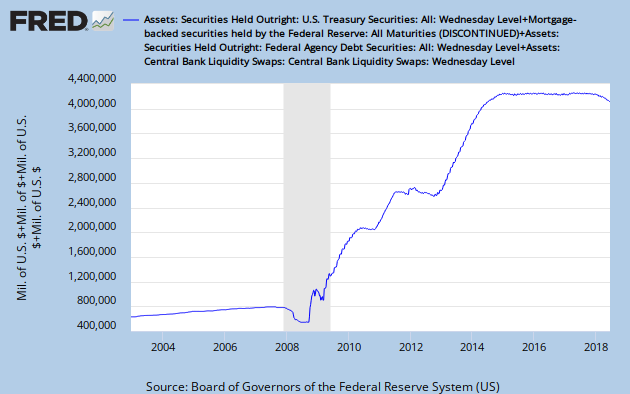
It's hard to understand why conservatives have been so up in arms about quantitative easing when you look at the reality. Yes, the Fed has expanded its balance sheet to unprecedented levels, but if it hadn't done that prices would probably be falling a bit now. But how will the Fed eventually mop up all this liquidity it's created -- hasn't it lit the fuse of an inflation time-bomb? No. The Fed can increase the interest it pays on reserves, do reverse repos, or use term deposit facilities to prevent banks from lending out too much money, if it comes to that.Why conservatives are pushing this poppycock, I just don't understand.
The gold standard is a solution in search of a problem. Actually, it's worse than that. It's a problem in search of a problem. Prices would have to fall a great deal if we adopted the gold standard today. In other words, it would turn the imagined problem of price stability into a real problem of price stability. And, of course, this ensuing deflation would send the economy into a death spiral due to still high levels of household debt.Whether it's 1896 or 2012, it doesn't make sense to crucify our economy on a cross of gold.
Friday, February 10, 2012
Warren Buffett On Gold
An investment that doesn't make sense (h/t Yglesias):
Over the past 15 years, both Internet stocks and houses have demonstrated the extraordinary excesses that can be created by combining an initially sensible thesis with well-publicized rising prices. In these bubbles, an army of originally skeptical investors succumbed to the "proof " delivered by the market, and the pool of buyers -- for a time -- expanded sufficiently to keep the bandwagon rolling. But bubbles blown large enough inevitably pop. And then the old proverb is confirmed once again: "What the wise man does in the beginning, the fool does in the end."Seriously, farmland may be a bubble, but it's better than gold. I don't completely get the gold fetish, but I did buy a few coins because they are cool looking. It's probably about time to sell.
Today the world's gold stock is about 170,000 metric tons. If all of this gold were melded together, it would form a cube of about 68 feet per side. (Picture it fitting comfortably within a baseball infield.) At $1,750 per ounce -- gold's price as I write this -- its value would be about $9.6 trillion. Call this cube pile A.
Let's now create a pile B costing an equal amount. For that, we could buy all U.S. cropland (400 million acres with output of about $200 billion annually), plus 16 Exxon Mobils (the world's most profitable company, one earning more than $40 billion annually). After these purchases, we would have about $1 trillion left over for walking-around money (no sense feeling strapped after this buying binge). Can you imagine an investor with $9.6 trillion selecting pile A over pile B?Beyond the staggering valuation given the existing stock of gold, current prices make today's annual production of gold command about $160 billion. Buyers -- whether jewelry and industrial users, frightened individuals, or speculators -- must continually absorb this additional supply to merely maintain an equilibrium at present prices.
A century from now the 400 million acres of farmland will have produced staggering amounts of corn, wheat, cotton, and other crops -- and will continue to produce that valuable bounty, whatever the currency may be. Exxon Mobil (XOM) will probably have delivered trillions of dollars in dividends to its owners and will also hold assets worth many more trillions (and, remember, you get 16 Exxons). The 170,000 tons of gold will be unchanged in size and still incapable of producing anything. You can fondle the cube, but it will not respond.
Thursday, February 2, 2012
The King Gold Bug Speaks
Jim Grant, who Newt Gingrich and Ron Paul always bring up, on returning to the gold standard (via Ritholtz):
Grant calls the gold standard “the least imperfect monetary system.” He notes that our present regime of purely paper currency is new: It only dates back to Richard Nixon.Wow. Talk about a disaster. How does one get rid of all the excess paper money in the world with gold fixed around $2500 an ounce? Wouldn't it be smart then to demand gold for all your dollars? What a deflationary mess. Oh well, this would be the plan of today's Republican party.
I asked him, whimsically, what he’d do if he actually were to be named chairman of the Fed. He said he’d begin by communicating to the public why the present system was so wrong, and needed to be changed. He’d make the case for the gold standard.
“I would then lay out a timeline for the conversion to a constitutional dollar, a dollar as envisaged by the Founding Fathers. “ A dollar, he says, is supposed to be a fixed measure, “like a foot, or a pound,” not something that can be redefined every few weeks by the Fed.
In his ideal world, says Grant, he would lay out a three-year program to convert back to the gold standard, probably at around $2,500 per ounce of gold. He adds that he would take great care to avoid the notorious blunder made by Winston Churchill and the British back in 1925, when they went back on the gold standard at too high a price, and imposed brutal deflation on the economy. Alas, he admits, this would need an act of Congress.
He added that he would also wind down the Fed’s bloated balance sheet, selling assets for gold, and he would shut down the Fed’s open market activities completely, relying instead on the discount window alone. The Fed, he said, shouldn’t be going out into the market to provide liquidity. It should simply be there to provide temporary liquidity to solvent banks when they ask, and on the basis of good collateral.
For good measure, he’d also push for a repeal of a 1935 New Deal law that protected bank investors from runs on their financial institutions. Before the law, he notes, if a bank got into trouble, the investors were on the hook to bail it out: After all, it was their bank. The same was true of the partners in a Wall Street brokerage. The system of taxpayer bailouts, like that of paper money, is a modern innovation.
Monday, January 23, 2012
What Is Money?
Ritholtz features a quote from Jeremy Irons in the movie Margin Call:
In all the discussion about the gold standard and fiat money, the thing about money being made up is so often overlooked. It is a medium of exchange, and worthless if other people don't believe it has value. What is gold going to do for you that eggs can't? What is all that paper in your wallet good for if people quit believing in its value? The value of money is a fiction everyone has a stake in continuing to believe in. That is the key job of the policy makers in trying to avoid crises. Make sure people don't lose faith in money, and the system it supports. If that goes, there will be chaos. You don't need a gold standard to maintain that belief. In fact, the gold standard makes the situation worse, because it prevents printing money to aleviate deflation.“Its just money; its made up. Pieces of paper with pictures on it so we don’t have to kill each other just to get something to eat. It’s not wrong. And it’s certainly no different today than its ever been. 1637, 1797, 1819, 37, 57, 84, 1901, 07, 29, 1937, 1974, 1987 — Jesus, didn’t that fuck up me up good — 92, 97, 2000 and whatever we want to call this [2008].
It’s all just the same thing over and over; we can’t help ourselves. And you and I can’t control it, or stop it, or even slow it. Or even ever-so-slightly alter it. We just react. And we make a lot money if we get it right. And we get left by the side of the side of the road if we get it wrong.
And there have always been and there always will be the same percentage of winners and losers. Happy foxes and sad sacks. Fat cats and starving dogs in this world. Yeah, there may be more of us today than there’s ever been. But the percentages-they stay exactly the same.”
Tuesday, January 17, 2012
Chart of the Day
Goldbugs, from a story about the new gold rush in the Klondike:
 Don't get me wrong, I bought some gold a few years ago because I think the coins are cool looking and I figured people would pour into gold. I just don't understand the draw of hard money.

Friday, January 6, 2012
All About Gold
From Ritholtz, gold facts and figures:

$8.7 trillion of gold above ground in the whole world at $1600 an ounce? No wonder the gold bugs salivate at the idea of returning to the gold standard. I hate to break it to them, converting to a monetary system that ridiculously increases the value of some damn not very useful metal at the expense of everybody who doesn't hoard it-not going to happen.
$8.7 trillion of gold above ground in the whole world at $1600 an ounce? No wonder the gold bugs salivate at the idea of returning to the gold standard. I hate to break it to them, converting to a monetary system that ridiculously increases the value of some damn not very useful metal at the expense of everybody who doesn't hoard it-not going to happen.
Friday, December 30, 2011

Friday, December 23, 2011
Gift Wrapping Is Overrated
Marketplace:
The show also featured a bit of News of the Obvious: Ron Paul invests heavily in gold. Whodathunkit? Well at least that has paid off well for him the last few years. If he were wise, he'd probably cash out. He won't.
Novemsky: So we were very interested in this question of how gift wrapping influences peoples reactions to gifts -- how much they like them. And also their willingness to reciprocate to the gift giver. I've had this experience some time ago -- giving my wife gifts -- where I would try to go the extra mile -- get the fancy bow and the nice wrapping -- every time I gave her something. And I'd notice a little ting in her eye when she would open the gift that almost suggested she was a little disappointed sometimes. So that encouraged us to run a few studies to give people gifts and see how they reacted to the same gift -- depending on how it was wrapped. And one of the interesting findings was that if you wrap a gift, you raised peoples expectations and the liking of the same gift goes down. If you wrap a gift that, you know, is really just meant to be a little something, it might behoove you not to wrap it -- or if you are going to wrap it, to not wrap it so nicely.A case where science indicates that positive outcomes correspond with laziness. I like that.
Moon: Now we're not just talking about the kind of wrapping paper, we're talking about not wrapping a gift at all to keep expectations lower.
Novemsky: That's right. Because you can imagine that -- especially as a gift that's wrapped sits under the Christmas tree for, you know, days or weeks, for example -- you start to imagine what's in there and you get pretty expectations. And when Christmas finally comes or the time comes to finally open that wrapping, you're imagining something great. Where as if I just say, "Here is something for you" and hand you something that you can immediately see, there's no chance for those expectations to creep up.
The show also featured a bit of News of the Obvious: Ron Paul invests heavily in gold. Whodathunkit? Well at least that has paid off well for him the last few years. If he were wise, he'd probably cash out. He won't.
Friday, December 2, 2011
The Origin of Money and Debt
Dan Little reviews David Graeber's Debt: The First 5,000 Years (h/t Mark Thoma):
One of Graeber's recurring themes is that money and debt are reciprocals of each other. He tells many stories about IOU's being passed around within a community: John promises to give X to Alice; Alice passes on the IOU to Robbie in exchange for a beer; Robbie takes the IOU to the nail shop and exchanges it for a pound of nails from Bert; and Bert eventually comes back to John to redeem the IOU. In this circuit, the statement of debt serves as a basis for folk currency within a local society. But Graeber argues that the establishment of Bank of England resulted in bank notes that were no more or less than IOU's from the state (49).
Another theme that comes into the book is the close connection that Graeber draws between money and currency, and violence and war. He argues that trust and extended credit arrangements work very well during periods of peace; whereas a period of extended warfare puts a premium on the portability and anonymity of precious metals. So warfare pushes societies (and monarchs) towards the use of currency made out of precious metals. He goes further: monarchs needed to pay their armies, in Europe, central Asia, and East Asia; and precious metals (coins) work best for the heavily armed and footloose soldiers who made up those armies.
Subscribe to:
Posts (Atom)